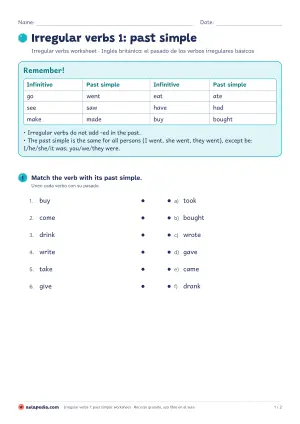
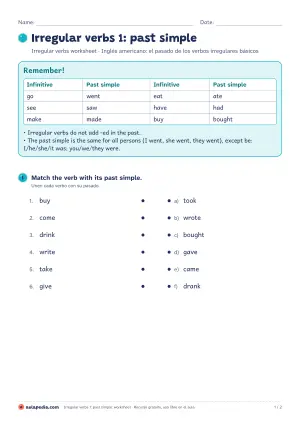
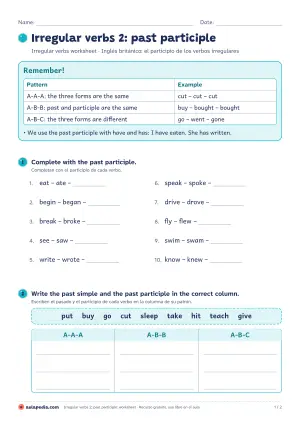
Dos hojas en inglés americano, nivel 3 de 3, para practicar el pasado y el presente perfecto con verbos irregulares: un recuadro «Remember!» y cuatro actividades de menos a más, con la consigna en inglés y una línea en español para el docente. Detrás va la misma ficha con las soluciones en rojo.
Versión en inglés americano: movie (en la de España, film) y gotten (en la de España, got). Las líneas para el docente usan el español de México («encierran en un círculo» en lugar de «rodean»).
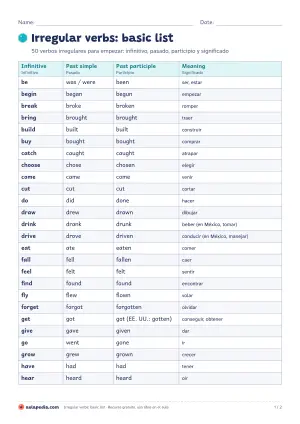
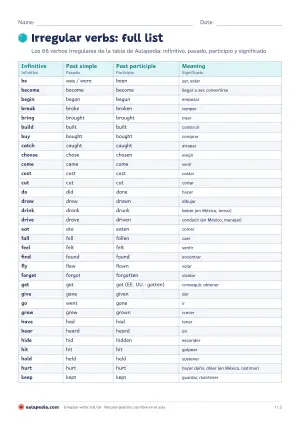
Los 14 verbos irregulares que se practican en la ficha, con sus tres formas en inglés americano:
- be – was / were – been
- ser, estar
- buy – bought – bought
- comprar
- eat – ate – eaten
- comer
- fly – flew – flown
- volar
- get – got – gotten
- conseguir, obtener; en inglés británico, el participio es got
- go – went – gone
- ir
- lose – lost – lost
- perder
- meet – met – met
- verse con alguien
- ride – rode – ridden
- andar en bici
- see – saw – seen
- ver
- tell – told – told
- contar, decir
- wear – wore – worn
- usar
- win – won – won
- ganar
- write – wrote – written
- escribir
Por su forma, seis tienen el pasado y el participio iguales (A-B-B: buy, get, lose, meet, tell y win) y ocho tienen tres formas distintas (A-B-C).
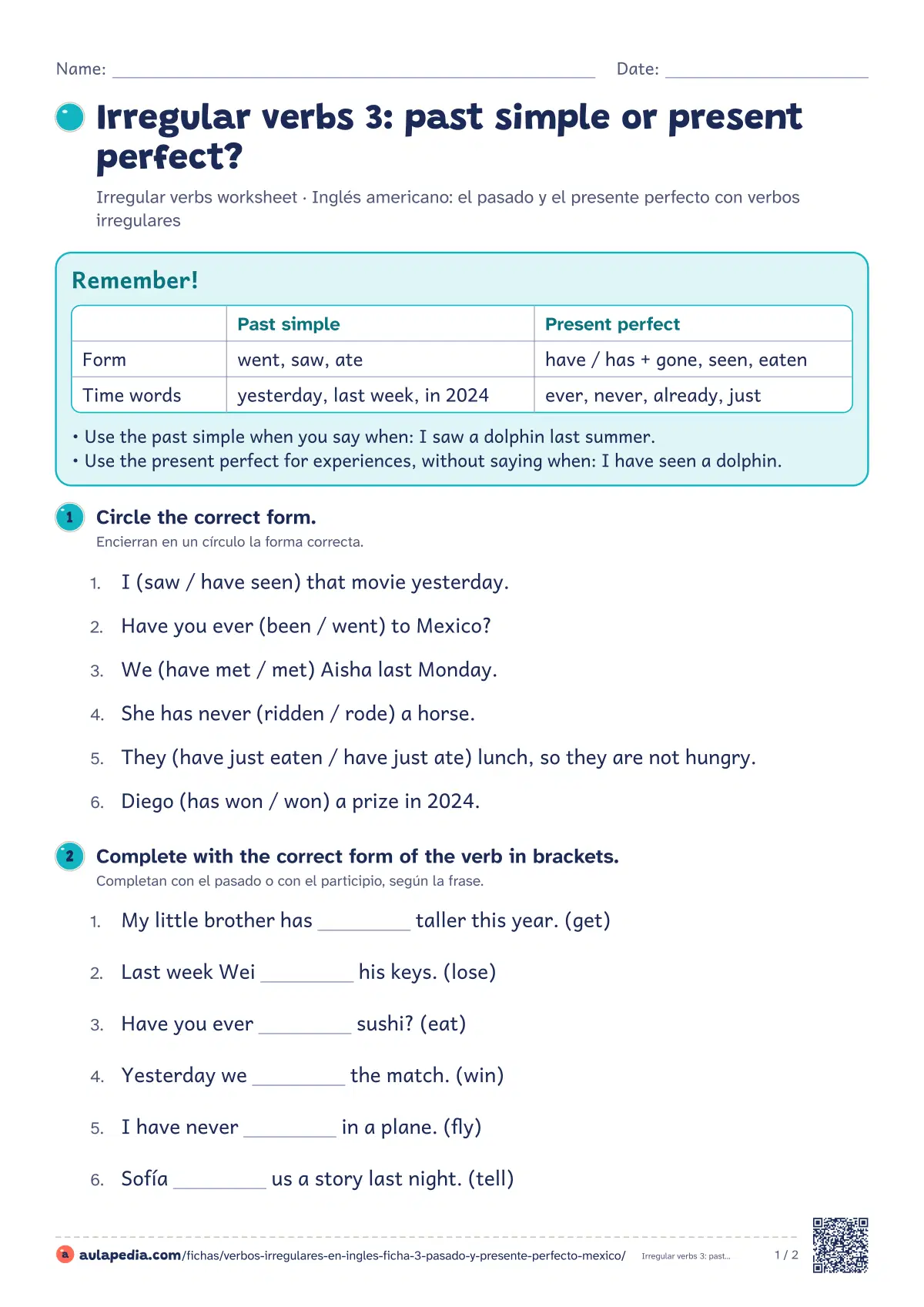
Recuadro «Remember!» de la primera hoja| — | Past simple | Present perfect |
|---|
| Form | went, saw, ate | have / has + gone, seen, eaten |
| Time words | yesterday, last week, in 2024 | ever, never, already, just |
Use the past simple when you say when: I saw a dolphin last summer.
Use the present perfect for experiences, without saying when: I have seen a dolphin.
Actividad 1, con seis frases. Encierran en un círculo la forma correcta.
1. Circle the correct form.
1. I (saw / have seen) that movie yesterday.
2. Have you ever (been / went) to Mexico?
3. We (have met / met) Aisha last Monday.
4. She has never (ridden / rode) a horse.
5. They (have just eaten / have just ate) lunch, so they are not hungry.
6. Diego (has won / won) a prize in 2024.
Actividad 2, con seis frases. Completan con el pasado o con el participio, según la frase.
2. Complete with the correct form of the verb in brackets.
1. My little brother has ____ taller this year. (get)
2. Last week Wei ____ his keys. (lose)
3. Have you ever ____ sushi? (eat)
4. Yesterday we ____ the match. (win)
5. I have never ____ in a plane. (fly)
6. Sofía ____ us a story last night. (tell)
Actividad 3, con cuatro frases y un ejemplo resuelto. Reescriben cada frase en pasado con la expresión de tiempo.
3. Write the sentences in the past simple. Use the time word.
Example: I eat an apple. (yesterday) → I ate an apple yesterday.
1. We go to the museum. (last Saturday)
2. She writes an email. (this morning)
3. They buy some bread. (yesterday)
4. He wears a blue hat. (last winter)
Actividad 4, con tres comienzos de frase. Escriben sobre sí mismos con el presente perfecto y con el pasado.
4. Write about you.
1. This year I have ____
2. I have never ____
3. Last summer I ____